Decentralized VPN intelligence

Privacy that can’t be shut down, logged, or subpoenaed.

A decentralized VPN (dVPN) replaces the single company server with a permissionless network of independent operators. Discovery, sessions and payments settle on-chain — so there is no headquarters to raid, no database to seize, and no invoice tying your name to your traffic.

  • No central servers
  • No account email
  • Crypto & privacy-coin payments
network://session
01 You encrypted client
02 Entry relay sees IP · not destination
03 Mixnet / mid relay adds noise & delay
04 Exit node sees destination · not IP
authorization: on-chain session tx ✓
0users on Sentinel dVPN apps
0P2P bandwidth providers
0countries across the networks
0Anyone network relays

01 / The basics

What is a decentralized VPN?

A traditional VPN is a company you rent a tunnel from. A decentralized VPN is a protocol you join. Instead of one operator owning every server, every key and every log, the network becomes a marketplace of independent node runners selling unused bandwidth. Your client discovers nodes, pays per gigabyte, and opens an encrypted tunnel — with no company sitting in the middle of the connection.

centralized

COMPANY
  • One operator sees every route
  • One jurisdiction, one company
  • “No logs” is a policy promise
  • Seize the servers, the network stops

decentralized

YOU
  • No single node sees the whole path
  • Operators spread across 70+ countries
  • Central logging is architecturally impossible
  • Kill one node — the mesh routes around it

Permissionless supply

Anyone with an internet connection can run a node and monetize idle bandwidth. Sentinel counts 1,500+ P2P bandwidth providers; Anyone reports 7,500+ active relays across 4,000+ distinct IPs.

Multi-hop by design

Traffic can be split over entry and exit nodes — and in Nym’s case five hops through a noise-generating mixnet. The entry node knows your IP but not your destination; the exit node knows the destination but never your IP.

Metered, pay-per-gigabyte

Subscriptions still exist, but the native model is metered: you buy bandwidth from the exact node you use, per session. VeilDVPN sells pay-as-you-go access priced strictly on the gigabytes or hours consumed.

No account, no identity

NymVPN signs you in with an anonymous 24-word passphrase — no name, no email, no trace. VeilDVPN requires no email, phone number or KYC. There is no user database to leak, sell or hand over.

02 / Threat model

Resilient and censorship-resistant by architecture, not by promise

Censorship resistance is not a marketing checkbox — it is the measured answer to one question: what still runs after someone blocks, seizes or bans the thing they can see? Centralized services have an address, an owner and a domain. dVPN networks have neither a required entry point nor a single party that can be coerced into shutting them down.

01

No single point of failure

Users reach nodes directly instead of passing through company infrastructure. There is no relay layer to block and no central server that, when taken offline, disconnects the network.

02

Permissionless bootstrap

Discovery is a chain query, so it can’t be taken down. Sentinel’s registry has zero bootstrap nodes — any client can join with nothing more than an RPC endpoint, and anyone can run one, anywhere.

03

No single jurisdiction

There is no board to subpoena, no gag order to serve and no silent logging update to push. VeilDVPN frames it plainly: with no central corporate infrastructure and no single jurisdiction, the network is immune to legal coercion.

04

Unlinkability at the protocol layer

Nym turns “no-logs” from a policy into a network property: with a zero-knowledge design and no meaningful traffic logs, there is nothing to seize that could link you to what you do online.

Block the founding organisation. Block the bootstrap servers. What keeps running?

Discovery / bootstrap model across peer-to-peer networks — data as published by Sentinel, 2026.
Network Discovery Bootstrap Failure mode
Sentinel dVPN Cosmos-SDK chain None — any RPC endpoint Nothing to block; validators continue
Tor 9 directory authorities Directory authorities Compromise or block them and Tor falls
IPFS / Filecoin Kademlia DHT (libp2p) ~6 hardcoded peers Block the seeds and new nodes can’t join
BitTorrent Mainline Kademlia DHT ~5 hardcoded hosts Floodable; new users blocked at bootstrap
I2P Hardcoded reseed URLs ~8 reseed servers Block ~8 domains and newcomers can’t join
Sentinel comparison graphic versus I2P bootstrap model
Most P2P networks rely on fixed entry points a censor can block. Permissionless RPC endpoints mean the network stays reachable as long as one endpoint is up.

03 / Infrastructure

Why dVPNs lean on blockchain

Strip away the crypto jargon and a dVPN needs three things a company would normally provide: a directory of who is selling bandwidth, a trustless way to authorize and meter a session, and a way to pay strangers without either side knowing the other. A blockchain is simply the cheapest known way to do all three without an owner. As Sentinel puts it: “The blockchain is the backend.”

01

Direct node probe

The client sends an HTTPS request straight to the node’s remote address and gets back live status: protocol type, peer count, location and available bandwidth. Peer-to-peer, no relay.

02

On-chain session

A signed transaction writes an immutable session record to the chain — session ID, node address, account address — validated by consensus rather than trusted to a corporate database.

03

Verified handshake

The node queries the chain, verifies the session matches, and only then issues credentials. Authorization is cryptographic — no human in a support queue, no API key.

04

Encrypted tunnel

A WireGuard (Curve25519) or V2Ray (VLESS/VMess) tunnel opens directly between client and node. End-to-end encrypted, zero intermediaries, keys never leave your device.
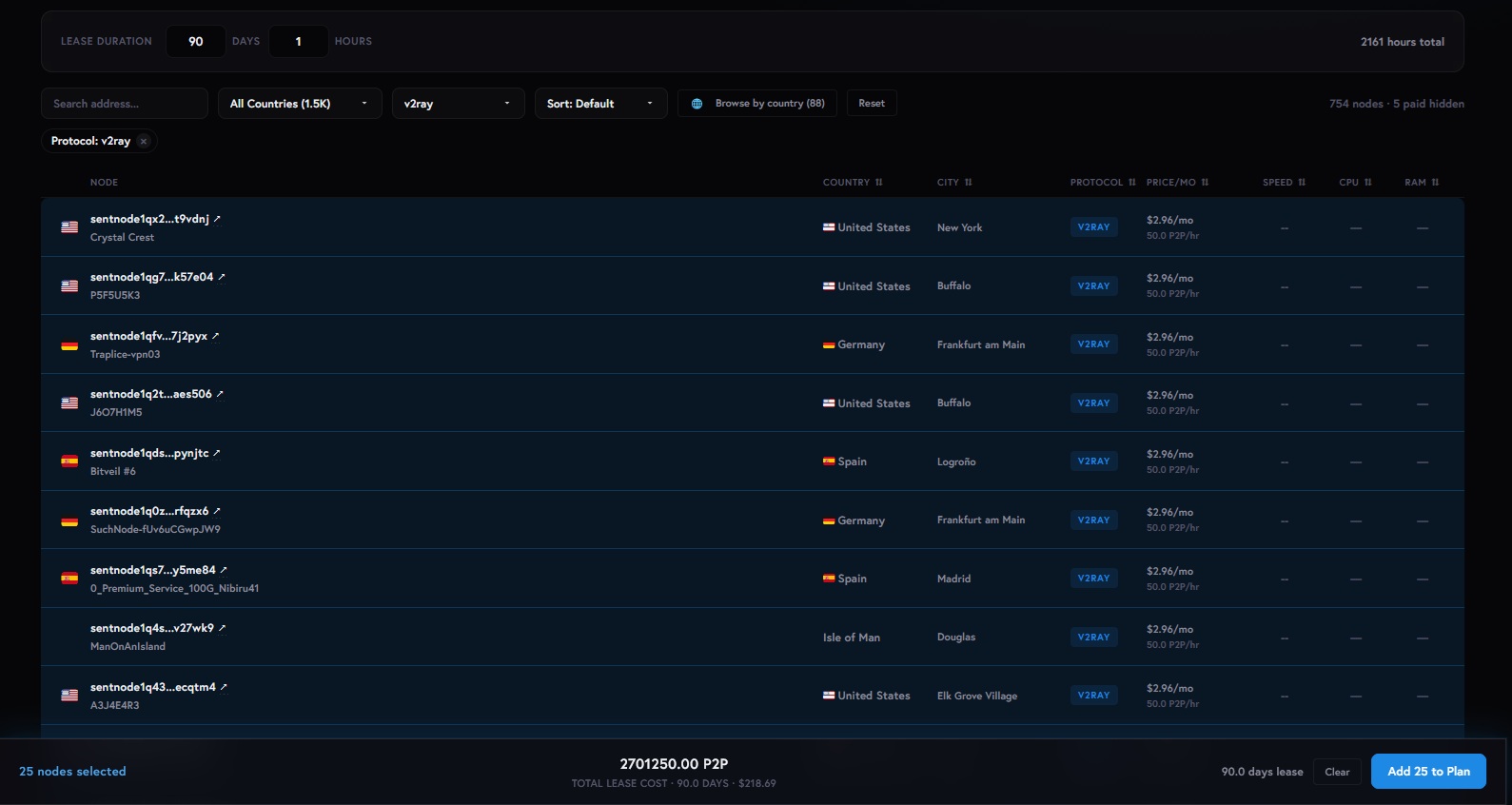
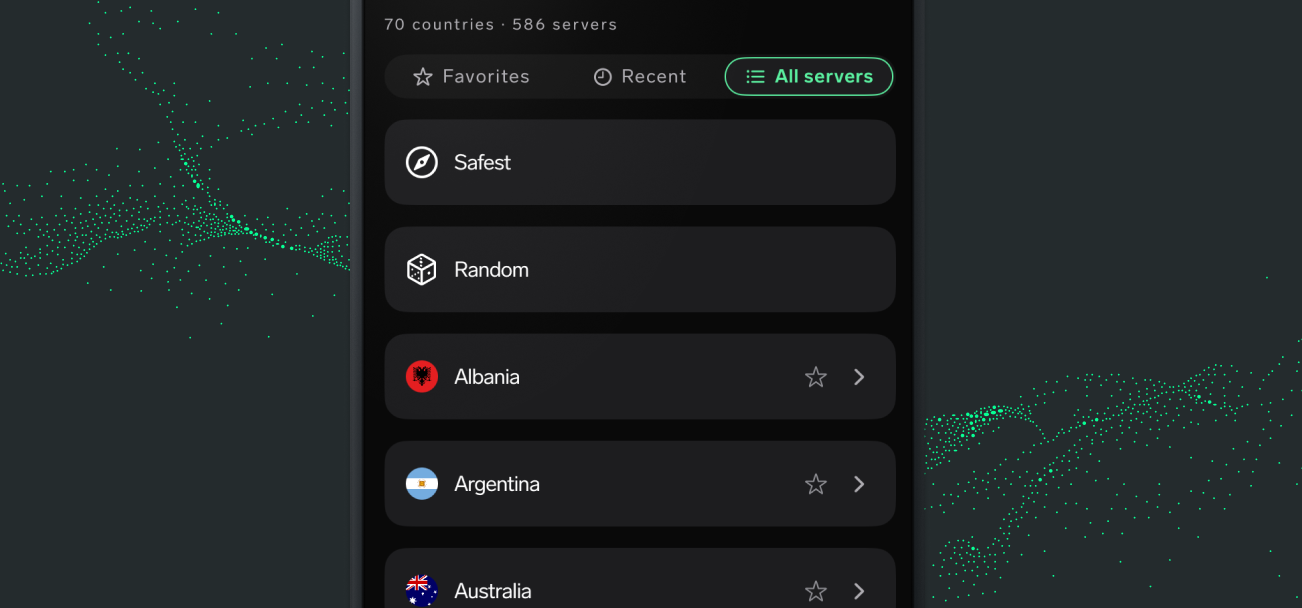
Sentinel dVPN subscriber plan and node selection interface
Sentinel — subscription plans and node discovery handled by the chain
Diagram of the Nym mixnet: cover traffic, packet mixing and timing delays across five hops
Nym — cover traffic (noise), five hops, Sphinx packet format, timing delays

The chain does what a company used to

  • A registry no one owns. Every node, session and account lives on-chain. Discovery is a chain query, so there is nothing to take down, and finality, Sybil resistance and governance come built in.
  • Validators as the compute layer. Sessions, plans and payouts are verified by validators who stake for the right to do so — governance is on-chain validator votes, not a board meeting.
  • Tokens as the incentive engine. Operators earn $NYM, $P2P or $ANYONE for relaying traffic. Fees are burned and redistributed, creating deflationary pressure and paying delegators.
  • DePIN economics. Decentralized physical infrastructure: thousands of individually owned machines — home connections, micro-datacenters, universities — become one network in exchange for token rewards.
  • Programmable, machine-payable access. Sentinel’s x402 flow lets an AI agent buy a full day of VPN for $0.033 in USDC on Base, settling in about two seconds — no API keys, no account, no human.
  • Reputation without identity. Nodes stake to participate; misbehaviour is slashable. Trust is economic, so it does not depend on knowing who anybody is.
$NYM

Powers NymVPN and the mixnet. Revitalizing the token, improving the mixnet and pushing decentralization further are headline goals of Nym’s roadmap.

$P2P

Sentinel’s native coin. Paying in it avoids the 10% surcharge Meile applies to non-P2P plan payments and funds buybacks and burns.

$ANYONE

Rewards relay operators on the Anyone network, which reports 80+ GB/s of aggregate bandwidth contributed by community hardware.

04 / Head to head

Decentralized VPN vs centralized VPN

Both hide your IP. Only one changes who you have to trust. The chart below contrasts a dVPN stack (Sentinel, Nym, Anyone) with a mainstream centralized provider represented here by NordVPN — a Panama-headquartered service with 7,000+ servers in 118+ countries, a third-party-audited no-logs policy, its own NordLynx (WireGuard-based) protocol and a conventional account-plus-subscription model.

Comparison of decentralized VPNs and centralized VPNs such as NordVPN
Dimension dVPNDecentralized network VPNCentralized provider (e.g. NordVPN)
Architecture A permissionless mesh of independent operators. Your client tunnels directly to a node you chose — no relay layer, no company in the path. One company owns and operates the fleet: 7,000+ servers in 118+ countries, with all traffic passing through corporate infrastructure.
Trust model Cryptographic. You verify the code and the chain instead of trusting a brand. Corporate. You trust a policy document and the audits that check it periodically.
Failure mode Block one node and traffic reroutes. There is no single entity whose disappearance ends the network. A company outage, seizure, sanction or domain block can disconnect every user at once.
Logging No central database exists to log into. Sentinel: “No company exists that could log your traffic.” “No logs” is a legal promise, not a technical guarantee — it stands or falls with the operator’s honesty and the auditor’s sample.
Jurisdiction The network spans thousands of sovereign operators and jurisdictions. Nothing singular to serve. One headquarters, one legal regime — subject to subpoenas, gag orders, NSLs and silent logging orders.
Discovery & bootstrap Discovery is a chain query against a consensus-protected registry; any RPC endpoint works, and anyone can run one. Discovery comes from the vendor’s app config and API endpoints — a finite, blockable surface.
Session authorization A signed transaction creates an on-chain session record; the node verifies it against the chain before issuing credentials. A token or credential issued by company servers after you log in with an account.
Account & identity NymVPN: an anonymous 24-word passphrase. VeilDVPN: no email, phone or KYC, ever. An account tied to an email address, with plan status and renewal history stored per customer.
Continued comparison: payments, identity linkage, metering, auditability, governance, price, speed and extras
Payments accepted Native tokens ($P2P, $NYM, $ANYONE), SOL, USDC on Solana, BTC, and privacy coins such as Monero (XMR), Zcash (ZEC), Zano and Firo Spark. Meile advertises 300+ cryptocurrencies; Nym accepts cash for complete tracelessness. Credit and debit cards, PayPal and regional wallets — with crypto, where offered, routed through a third-party payment processor rather than being native to the product.
Identity ↔ usage link Nym uses zero-knowledge technology so you stay unlinkable to your use of the app. Monero and shielded Zcash hide sender, receiver and amount; multi-hop routing separates your real IP from your destination. Your name, billing address, card or PayPal identifier and invoice history persist as a durable record — a billing relationship that maps a human to a subscription and every timestamp on it.
Metering Pay per gigabyte or per hour straight to the node, with the session cost committed on-chain. Meile adds a 4.2069% direct-session fee that is burned, airdropped to delegators and reinvested in development. A flat recurring subscription with auto-renewal. Usage is metered internally, if at all, and rarely surfaced to the customer.
Auditability Node, client, protocol and SDK are open source — anybody can follow the traffic path end to end. Server-side software is proprietary and unauditable; independent audits typically cover policy and apps rather than the fleet.
Governance On-chain validator votes. Protocol changes require network consensus. A corporate board. Policies can change with a terms-of-service update.
Typical price Metered from a fraction of a cent per GB — Sentinel quotes $0.033 for a full day via x402; VeilDVPN from $2.99/month; Meile basic $3.14/month. Monthly list pricing sits roughly an order of magnitude higher, discounted steeply when you prepay for one to three years.
Speed & consistency Variable by nature — you are using somebody’s spare bandwidth. Modern clients add obfuscation (AmneziaWG, Hysteria2, Xray) that punches through throttling. Generally faster and more predictable thanks to a purpose-built backbone. The trade-off is centralization.
Extras Run a node and earn tokens; NFT-gated perks such as Bluefrens granting a recurring free monthly subscription; community analytics dashboards. Tracker and ad blocking, mesh networking, dedicated IP add-ons, 24/7 human support and polished cross-platform apps.

Centralized-provider specifics are taken from publicly published material at the time of writing — server counts, jurisdictions and policies change, so verify with the vendor. dVPN figures come from the Sentinel, Nym, Anyone, Meile, VeilDVPN, Katacomb and ChibaTunnel project sites. Nothing here is legal, financial or investment advice.

Choose a dVPN when…

  • Metadata about how you use the network is itself sensitive — journalism, activism, dissident work.
  • You refuse to hand a company your legal identity in exchange for privacy.
  • You need access from a jurisdiction that blocks VPN hosts, and want residential IPs that look like ordinary home traffic.
  • You would rather verify open code and on-chain sessions than trust a no-logs marketing page.
  • You want to be a participant — running a node, earning tokens, or paying per gigabyte instead of per year.

A centralized VPN still wins on…

  • Raw throughput and consistent latency across thousands of servers.
  • One-click usability, native apps everywhere and 24/7 human support.
  • Bundled extras such as trackers blocked, dedicated IPs and mesh tools.
  • Corporate procurement, invoices and central fleet policies.
  • Cases where your threat model is a café Wi-Fi network, not a state adversary.

05 / Money & metadata

dVPNs take crypto. Traditional VPNs take your card.

Here is the part most comparison tables skip. A VPN can be perfectly encrypted and still betray you through its billing desk. If your subscription is paid with a credit card, then a name, a billing address, a bank and a purchase history are attached to the service that holds your traffic. Every dVPN in this guide inverts that: access is bought with cryptocurrency — and often with private cryptocurrency — so paying for privacy does not first require surrendering your identity.

Crypto-native rails

Meile accepts 300+ cryptocurrencies and flatly refuses fiat. VeilDVPN takes the native $P2P token, plus SOL and USDC on Solana. Sentinel’s x402 endpoint lets software pay for its own tunnel — $0.033 of USDC for a day, settling in ~2 seconds.

  • +300 coins
  • USDC
  • SOL
  • x402

Privacy coins for total anonymity

Nym accepts the widest spread of cryptocurrencies of any VPN we looked at — and explicitly highlights Zcash (ZEC) and Monero (XMR), the two currencies built to hide sender, receiver and amount. Nym also sells cash payments for full tracelessness.

  • XMR
  • ZEC shaded
  • cash
  • ZK login

The fiat identity ledger

Cards, PayPal and regional wallets leave a durable paper trail: name, billing address, bank, invoice history and renewal timestamps. Crypto offered by mainstream providers tends to pass through third-party processors that keep their own records — so the identity link survives even when the currency changes.
  • card
  • PayPal
  • KYC
  • invoice trail
Nym VPN private payments screen showing anonymous cryptocurrency payment options
Nym — private payments: anonymous accounts unlinked from what you pay with
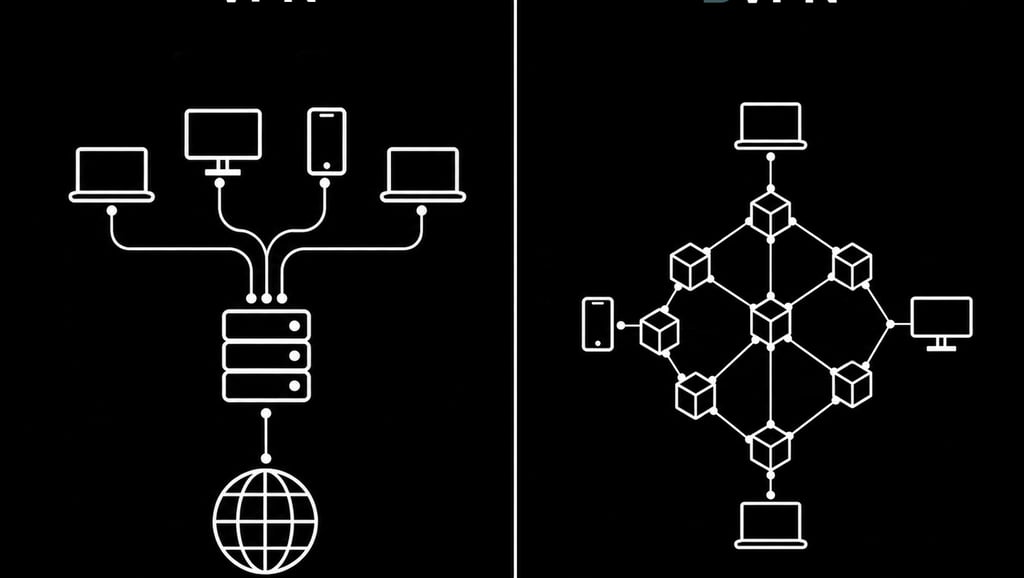
Illustration contrasting how a traditional VPN and a decentralized VPN route traffic
VeilDVPN — a distributed marketplace of independently operated nodes instead of one company’s infrastructure

Unlinkability is a stack, not a checkbox

  • Ring sessions. Meile v2.7.0 ships decoy session transactions by default, so a session on-chain does not advertise exactly which node you connected to.
  • Shielded assets. Meile recently added shielded ZEC via BTCPay, Zano confidential assets (BTCx, SOLx and friends), ZEPH/ZSD in-app payments, and the ability to buy SMS with Monero.
  • Unlinkable identity to usage. Nym’s zero-knowledge design means the network can authenticate a paying user without learning which user that is, or what they do.
  • No email, no KYC. VeilDVPN’s app asks for nothing personal; you create or import a wallet instead of an account.
  • Peer-to-peer pricing pressure. Meile adds a 10% surcharge to plans not paid in Sentinel’s native $P2P — an explicit nudge toward the unlinkable path.

06 / Featured networks

Three architectures worth studying

Nym, Sentinel and Anyone each solve the same problem differently: Nym adds noise and cryptographic unlinkability, Sentinel turns the blockchain itself into the backend, and Anyone sells hardware plus a three-relay circuit. Features and figures below are drawn from each project’s own site.
Nym nym.com

Noise protection · mixnet privacy · zero-knowledge accounts

Visit nym.com
NymVPN client interface: the anonymous decentralized VPN
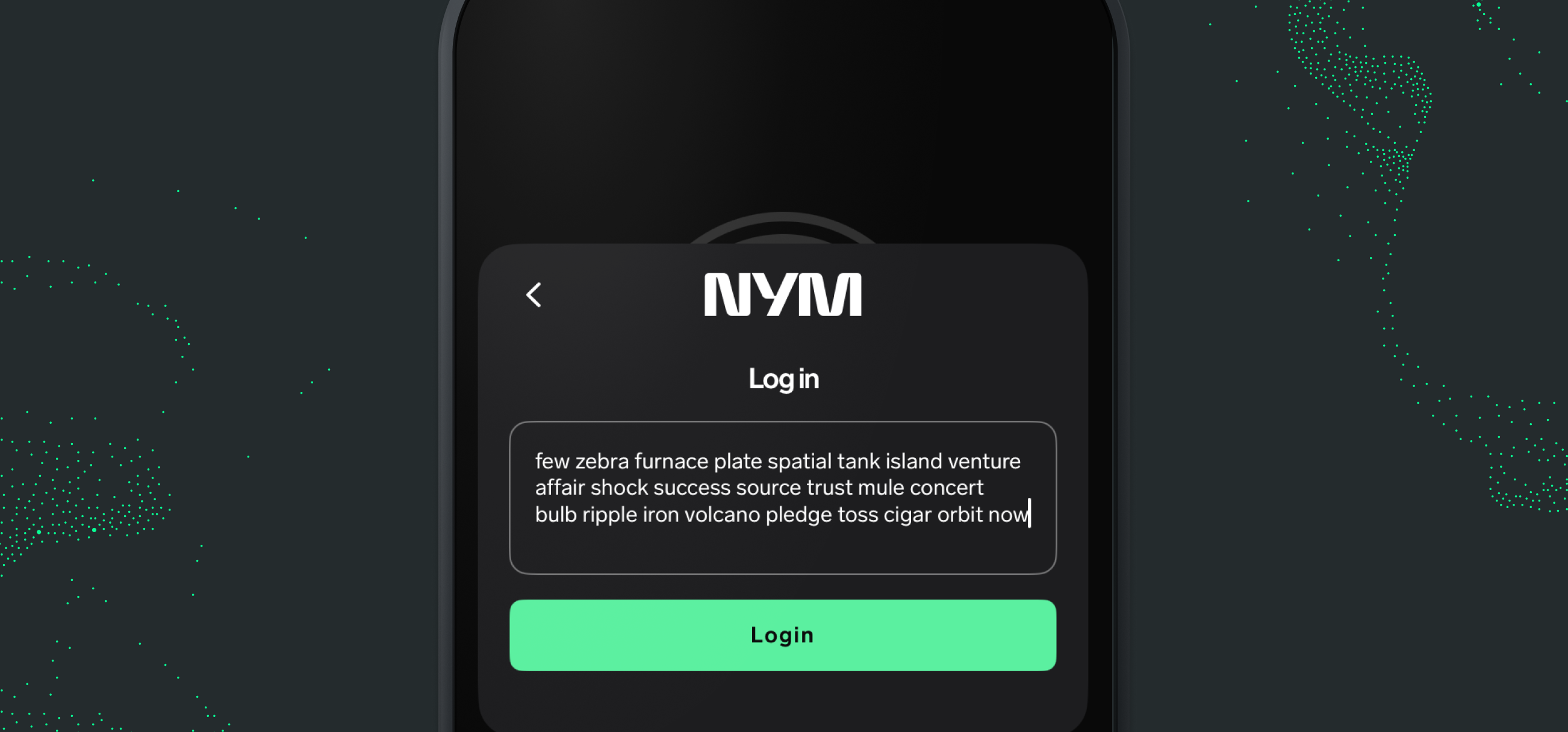
NymVPN anonymous sign-in using a 24-word passphrase
Anonymous sign-in
One-click connect options in NymVPN
One-click connect

Nym markets itself as “the world’s most private decentralized VPN”, and the claim rests on noise. NymVPN’s mixnet generates cover traffic so that the patterns your communications leave behind cannot be surveilled. Rather than a no-logs promise, unlinkability is baked into the network design: an anonymous 24-word passphrase replaces the account, and zero-knowledge payments keep you unlinkable to your own use of the app. It ships in two modes — a fast dVPN for daily browsing and the 5-hop mixnet with noise as the most anonymous way to be online.

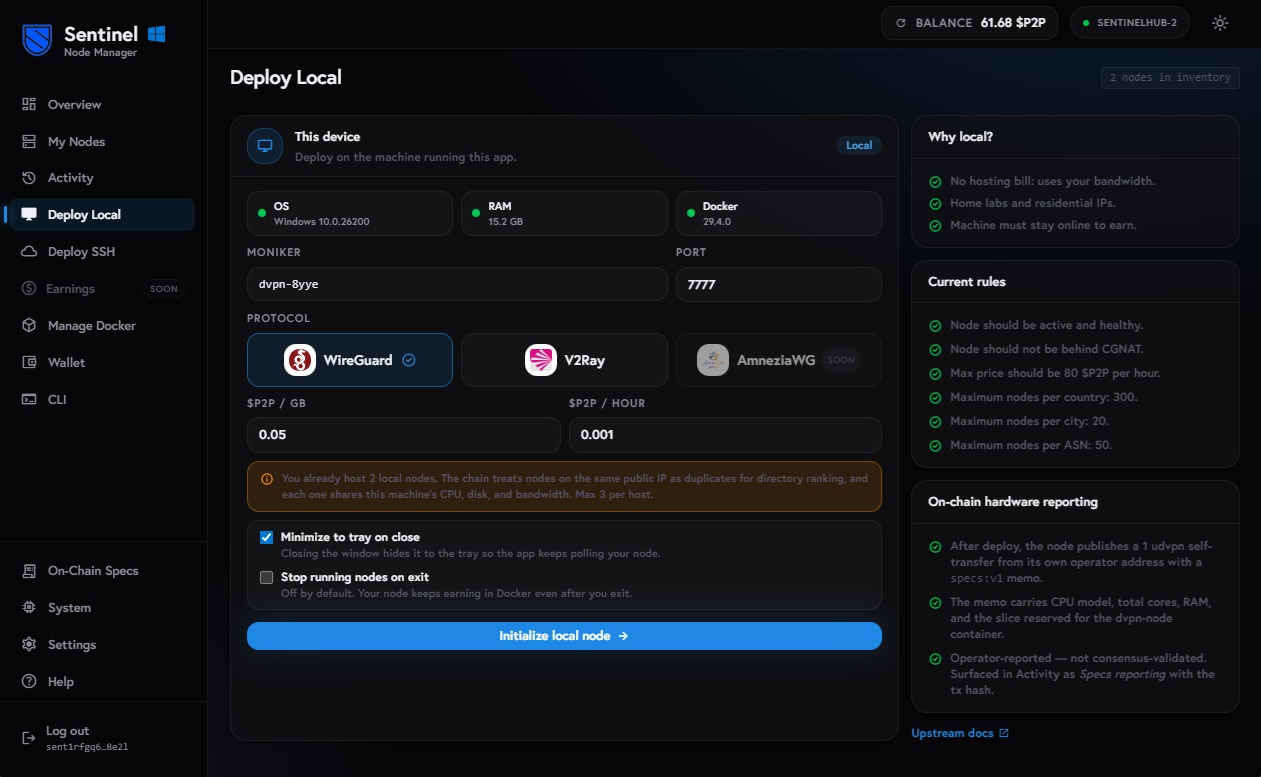
  • Two in-app modes: a fast decentralized VPN, or the mixnet with cover traffic, packet mixing and timing delays across 5 hops.
  • Anonymous accounts: no name, no email, no trace — access via a 24-word passphrase.
  • Private payments: most cryptocurrencies accepted of any VPN, privacy coins like Zcash and Monero, plus cash for full tracelessness.
  • Choose your path: pick entry and exit servers on a decentralized network run by an independent community — servers in 70+ countries and 800+ nodes, with residential IP support.
  • Independently audited across 2021, 2023, 2023–24 and 2024–25, with post-quantum key exchange via the Lewes Protocol already live.
  • Open source and permissionless, backed by academics and advisors including Chelsea Manning and Ben Laurie.
  • 5-hop mixnet
  • ZK payments
  • Post-quantum keys
  • Open source
  • Audited

Sentinel sentinel.co

Cosmos-SDK L1 · on-chain DHT · bandwidth marketplace

Visit sentinel.co
Sentinel network branding graphic
Sentinel node explorer interface listing peer nodes
Node explorer
Graphic representing the metadata patterns dVPNs protect
Metadata surface

Sentinel is the infrastructure layer other dVPNs are built on: a Layer 1 chain built with the Cosmos SDK that acts as a perpetual, on-chain distributed hash table for bandwidth. There are zero bootstrap nodes and no central servers to seize — discovery is a chain query and any client can join with nothing more than an RPC endpoint. Independent operators contribute bandwidth across 70+ countries, sessions are authorized by signed transactions, and the ledger of record is the blockchain itself.

  • 1.4M+ users across dVPN apps built on Sentinel, with 8+ dApps, 1,500+ P2P bandwidth providers and 6+ petabytes of data consumed.
  • “The blockchain is the backend.” Every node, session and account lives on-chain, with finality, Sybil resistance and governance built in.
  • Direct client-to-node tunnels over WireGuard (Curve25519) or V2Ray (VLESS/VMess) — keys never leave your device and no relay layer exists.
  • Consensus-validated sessions instead of corporate logging: on-chain authorization is cryptographic, not contractual.
  • White-label SDK: ship your own branded dVPN on a stack that already handles compute, bandwidth, payments and security.
  • Machine-native payments through x402: an agent can buy access for $0.033/day in USDC on Base with no API key or account.
  • Earn by hosting: node operators monetize spare bandwidth and are paid out by validators.
  • Cosmos SDK
  • On-chain DHT
  • Zero bootstrap
  • WireGuard + V2Ray
  • White-label SDK

Anyone Protocol anyone.io

Community relays · 3-hop circuits · hardware for everyone

Visit anyone.io
Anyone Protocol hero graphic: privacy you can finally trust
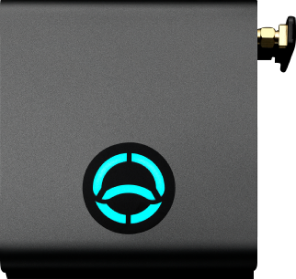
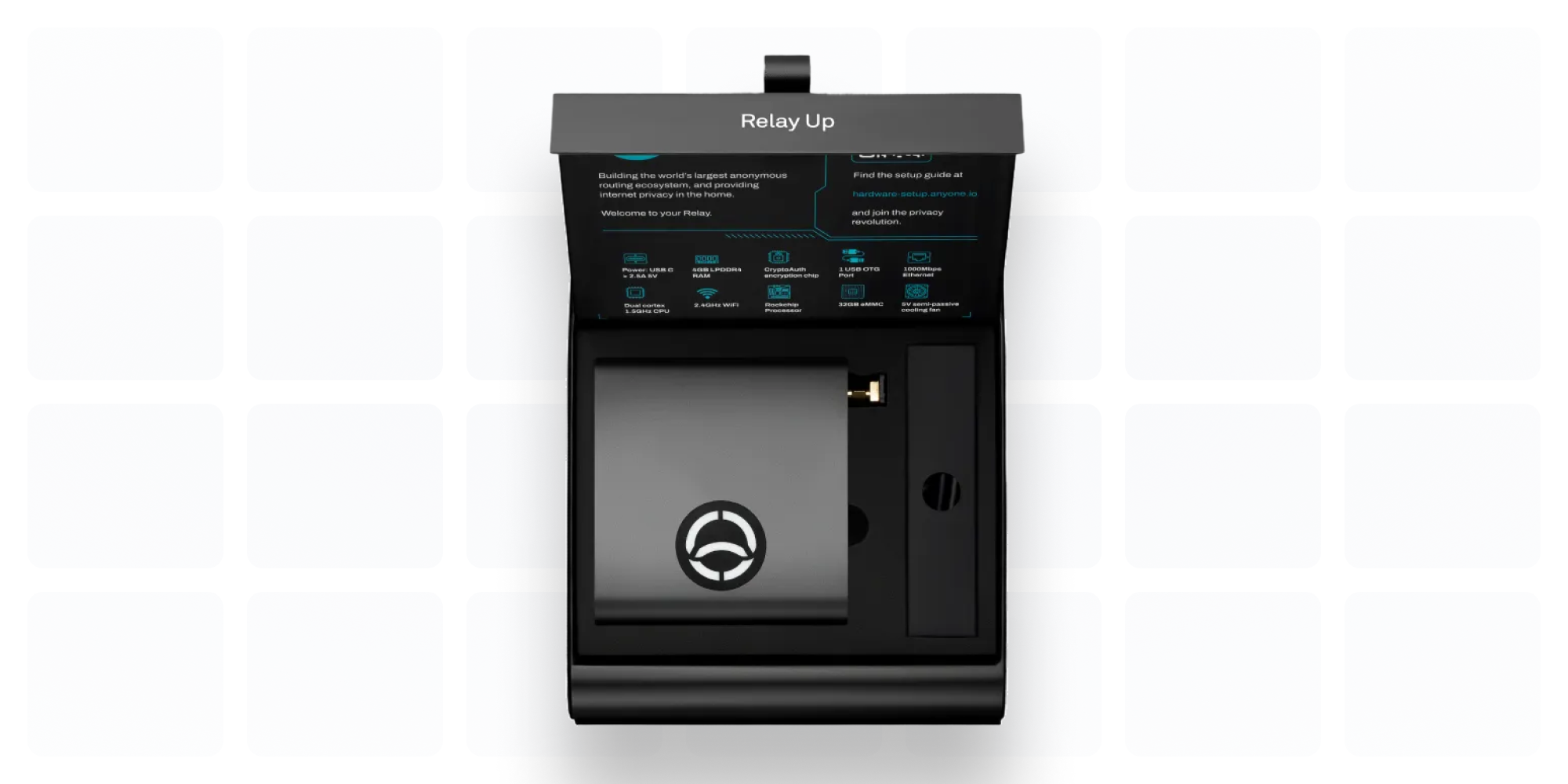
Anyone hardware router
Anyone Router
Anyone Protocol relay network graphic
Relay network

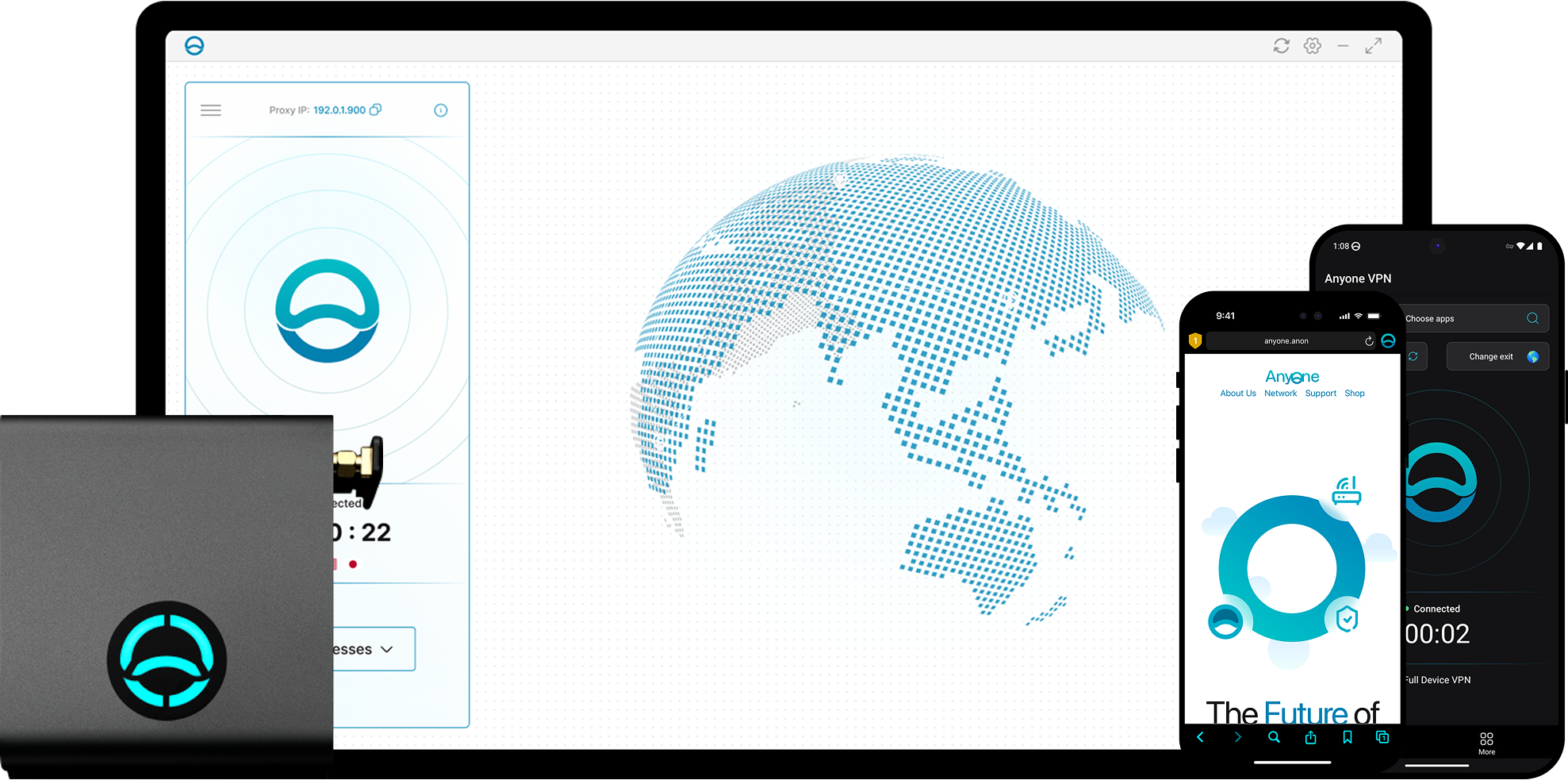
Anyone combines state-of-the-art encryption with a community-owned network of thousands of independent relays. There are no central servers and no single point of failure: no one, including the project itself, can control or see your data. Traffic is encrypted and anonymized across three secure relays, and the same network reaches beyond the app — an SDK for developers, a privacy browser, and a physical router that encrypts an entire home network while its owner earns rewards for relaying.

  • Scale: 7,500+ active network nodes, 4,000+ distinct locations and IPs, 80+ GB/s of aggregate bandwidth and 66,000+ npm installs.
  • 3-hop encryption and onion-style circuits: data is encrypted and anonymized across three secure relays before it ever reaches the destination.
  • No logs, no ads, no tricks — Anyone states that it does not and cannot store or track your data, and that you will never see ads.
  • Open source and permissionless: relays are run by regular people, with an open codebase and an SDK for building privacy-first apps.
  • Hardware option: the Anyone Router encrypts every device on a home network and contributes bandwidth back to the network for token rewards.
  • Cross-platform apps for iPhone, iPad, Android, Windows, macOS and Linux, plus a privacy app and browser.
  • 3-hop circuits
  • 7,500+ relays
  • Hardware router
  • SDK
  • $ANYONE rewards

07 / The dVPN stack

dVPN products you can install today

Six clients, six philosophies: Meile for crypto maximalists who want metered control, VeilDVPN for a minimalist Android experience with zero personal data, Anyone for hardware and three-relay circuits, Nym for mixnet-grade anonymity with a polished desktop app, Katacomb for Linux power users who want to chain their own hops, and ChibaTunnel for six protocols in one cross-platform client. Imagery and feature claims below come from each project’s own site.

Meile dVPN app splash screen
Kill switch & leak protection Live node monitoring

Meile dVPN

dvpn.app · MathNodes · built on Sentinel

Meile brands itself as unstoppable privacy: a desktop client that uses a decentralized network of nodes running on blockchain technology, drawn from datacenters, universities and homes worldwide, so there is no single point of failure. It is the most deliberately crypto-native client here — fiat is not accepted at all, the in-app wallet shows IBC balances across P2P, OSMO, SCRT, ATOM and NAM, and recent releases added ring sessions, shielded Zcash via BTCPay, Zano confidential assets and Hysteria2/XRay/AmneziaWG transports.

  • Broad platform support: Windows, macOS, Ubuntu, Debian, Fedora, Arch and ARM builds, installable and updatable over APT.
  • Two plans: Basic at $3.14/month (60+ nodes, 20+ countries) and Premium at $6/month (150+ nodes, 30+ countries), both with unlimited bandwidth over WireGuard and V2Ray.
  • 300+ cryptocurrencies accepted — fiat deliberately refused. A 10% surcharge applies to plans not paid in Sentinel’s native $P2P.
  • Privacy-first payment stack: ring sessions (decoy session transactions) by default, shielded ZEC via BTCPay, ZEPH/ZSD in-app payments, Zano confidential assets, and SMS purchasable with Monero.
  • Tokenomics that feed the network: a 4.2069% direct-session fee is randomly routed to 1-of-10 wallets — burned, airdropped to delegators, or reinvested in development, with P2P buybacks on the open market.
  • Polished UI: a stylish interface with a built-in wallet, a new 2D OSM map and node-detail pages, QR-connection sharing with mobile, and update notifications.
  • Gives back: 3.14% of all sales is donated to the Roman Storm legal defence case, and the project runs public analytics dashboards.
  • Desktop-first
  • 300+ coins
  • No fiat
  • Ring sessions
  • Sentinel dVPN
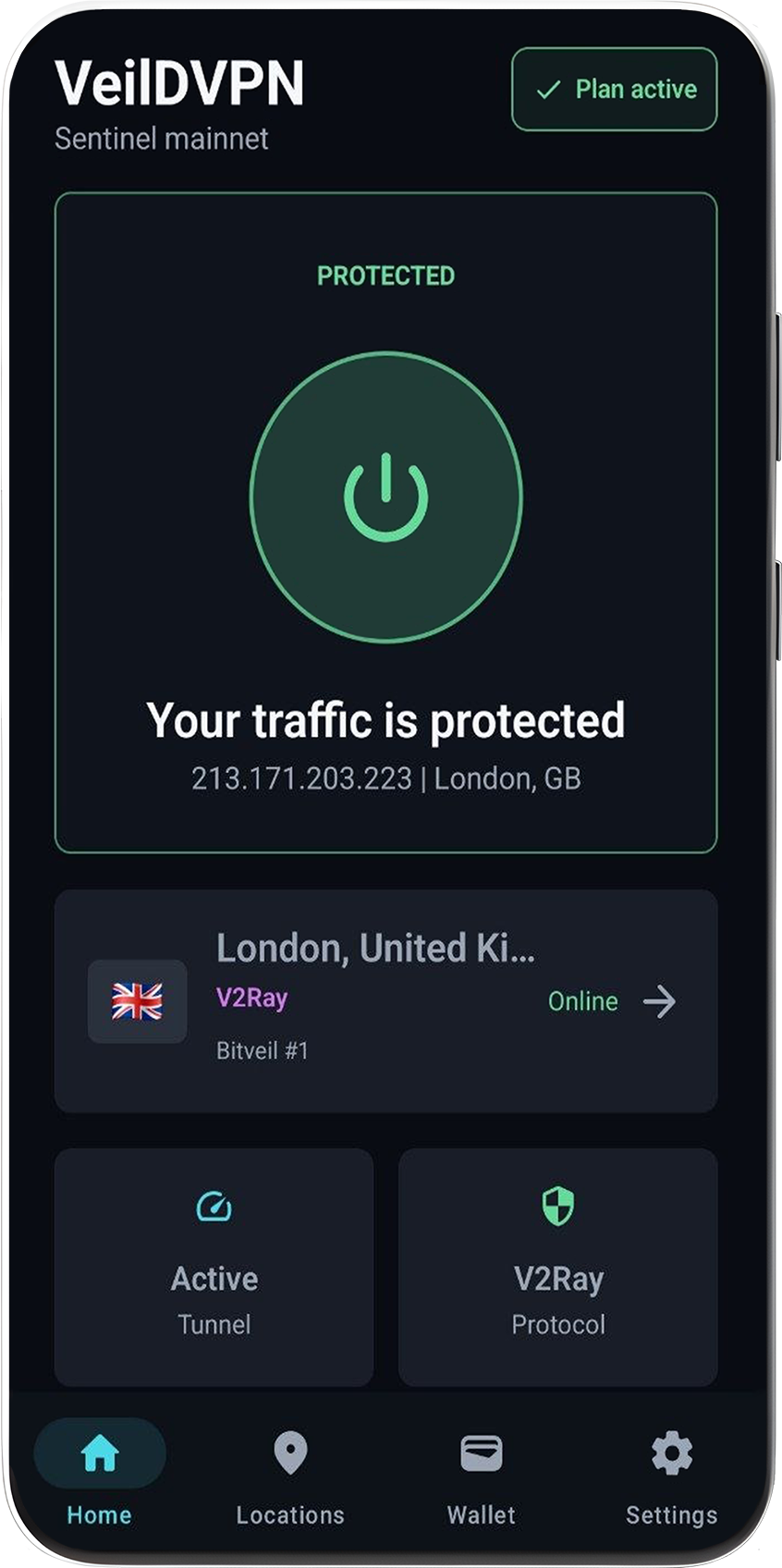
VeilDVPN Android app mockup
Android 8.0+ 5 protocols 1,300+ nodes

VeilDVPN

bitveil.com/veildvpn · Bitveil · built on Sentinel

VeilDVPN sells itself as decentralized privacy, made simple. Traditional VPNs route your traffic through infrastructure one company controls; VeilDVPN instead gives you access to a distributed marketplace of independently operated dVPN nodes, with sessions and payments coordinated on the Sentinel blockchain. Removing that central point of failure removes activity logging and central server bans as well — and because many nodes sit on residential connections, strict geo-blocks and streaming filters are far less likely to recognise you.

  • Five protocols in one app: WireGuard, AmneziaWG, V2Ray, Xray and Hysteria2 — routing, node type and transport are all user-selectable.
  • No email, phone number or personal information required — you create or import a self-custodied Sentinel wallet instead of an account.
  • 1,300+ community-hosted nodes spread across an open global community of individuals, community members and micro-datacenter operators.
  • Two ways to pay: pay-as-you-go directly to nodes in the native $P2P token for exactly the gigabytes or hours you use, or subscription plans priced in crypto including P2P, SOL and USDC on Solana.
  • Plans: 1 month at $2.99, or 6 months at $14.99 — a 16.44% discount — settled through an in-app wallet.
  • Multi-hop routing: chain two or more encrypted dVPN nodes so the entry node cannot see your destination and the exit node never sees your real IP.
  • Trustless privacy: end-to-end encryption happens on your device before traffic reaches a node, so hosts route scrambled packets they cannot inspect, decrypt or log.
  • Bluefrens perk: holders of the first NFT collection built for the Sentinel ecosystem can deposit an NFT into the app wallet to redeem a free monthly subscription, re-claimable every 30 days.
  • Install from source you trust: a standalone APK from the official site, or the official F-Droid repository for automatic updates.
  • Android
  • Pay-as-you-go
  • No KYC
  • Multi-hop
  • Bluefrens NFT
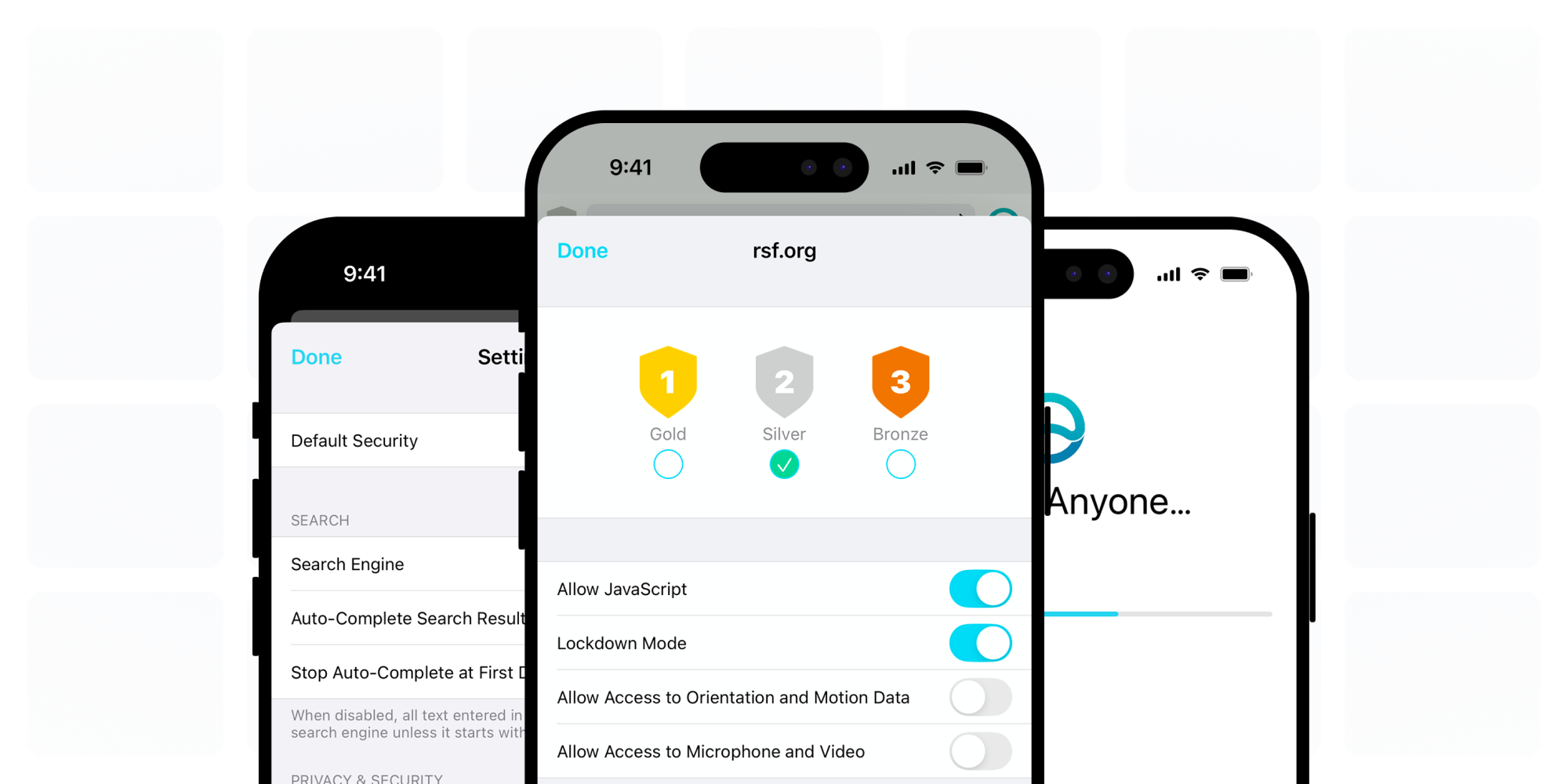
Anyone app graphic showing devices protected by the network
iOS · Android · Desktop 3-hop · 7,500+ relays

Anyone

anyone.io · $ANYONE · community relays

Anyone is the consumer face of the Anyone Protocol: an app and browser that connect to an encrypted, community-owned network with no central servers and no single point of failure. Every connection is anonymized across three relays, so no relay knows both who you are and where you are going. The same network is available as hardware — the Anyone Router encrypts an entire home network and earns tokens for relaying — and as an SDK for developers building privacy-first products, from AI agents to home automation.

  • Everything on the network is encrypted end to end and routed through 3 relays, with no logs stored and no ads shown — privacy by design rather than by promise.
  • Installable everywhere: iPhone/iPad, Android, Windows, macOS and Linux apps, plus a privacy browser and the hardware router.
  • Contribute and earn: run a relay on your own hardware or buy an Anyone Router, encrypt your whole home network and collect $ANYONE rewards.
  • Developer SDK: integrate decentralized privacy into your own apps — the network reports 66,000+ npm installs.
  • Performance focus: the project’s stated goal is privacy that is “fast and reliable”, optimized for speed with 80+ GB/s of network-wide bandwidth.
  • Community-governed: an open-source, permissionless network of thousands of independently operated relays — no one, not even the team, can see your traffic.
  • Free app
  • 3-hop
  • Router hardware
  • Run a relay
  • Open source
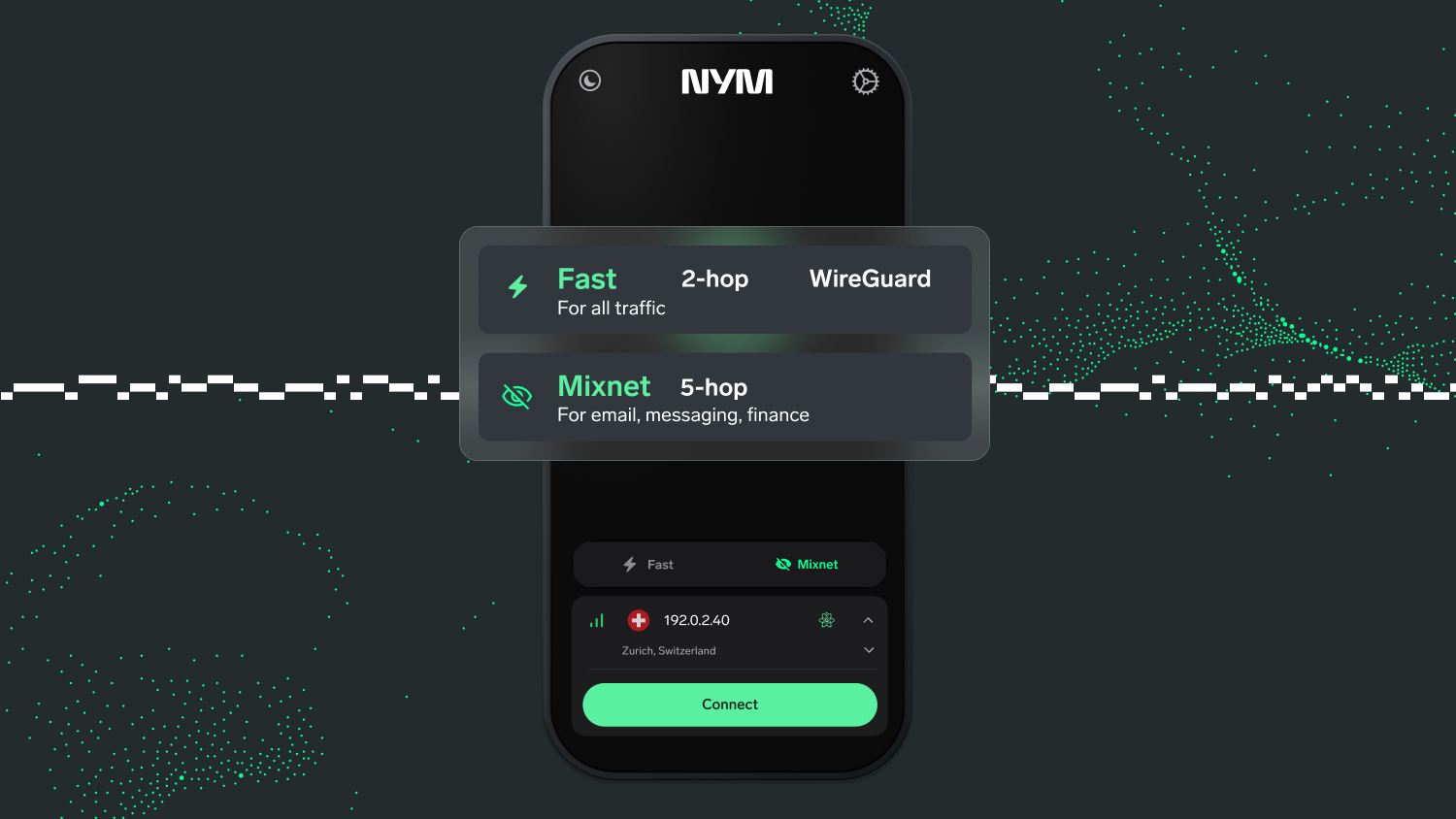
NymVPN interface showing the fast dVPN mode and the mixnet mode
5-hop mixnet Audited 70+ countries

NymVPN

nym.com · $NYM · mixnet privacy

NymVPN is the flagship app of the Nym network — “the anonymous decentralized VPN”. Its differentiator is a choice of anonymity: a fast decentralized VPN mode for everyday browsing, or the Noise Generating Mixnet that adds cover traffic, packet mixing and timing delays across five hops. Sign-up is a 24-word passphrase rather than an account, and payments are built to be unlinkable, with privacy coins and even cash supported. Nym also publishes independent audit reports covering 2021 through 2025 and has begun shipping post-quantum key exchange.

  • Two modes, one app: fast dVPN for daily use, or the 5-hop mixnet with cover traffic for the most anonymous way to be online.
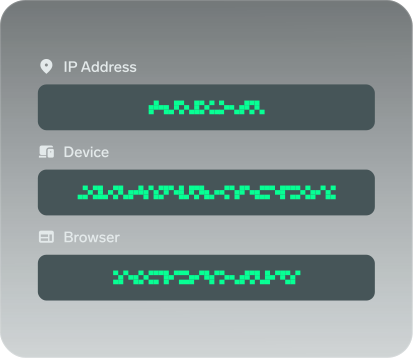
  • Anonymous by default: no personal information for sign-up, no logs because Nym cannot log, and unlinkability all the way through to payments.
  • Private payments: the widest range of cryptocurrencies accepted by any VPN, including Zcash (ZEC) and Monero (XMR), plus cash payments for full tracelessness.
  • Pick your path: choose entry and exit servers, with residential IP support across 800+ nodes in 70+ countries.
  • Recent client features: one-click connections, geo-exclusion with split tunnelling, faster cellular connections, mixnet tuning controls and five new languages.
  • Try before you commit: a 7-day free trial, with up to 75% off when paying with $NYM.
  • Available on Android, iOS, Linux, macOS and Windows.
  • dVPN + mixnet
  • Passphrase login
  • XMR · ZEC · cash
  • Post-quantum
  • 7-day trial
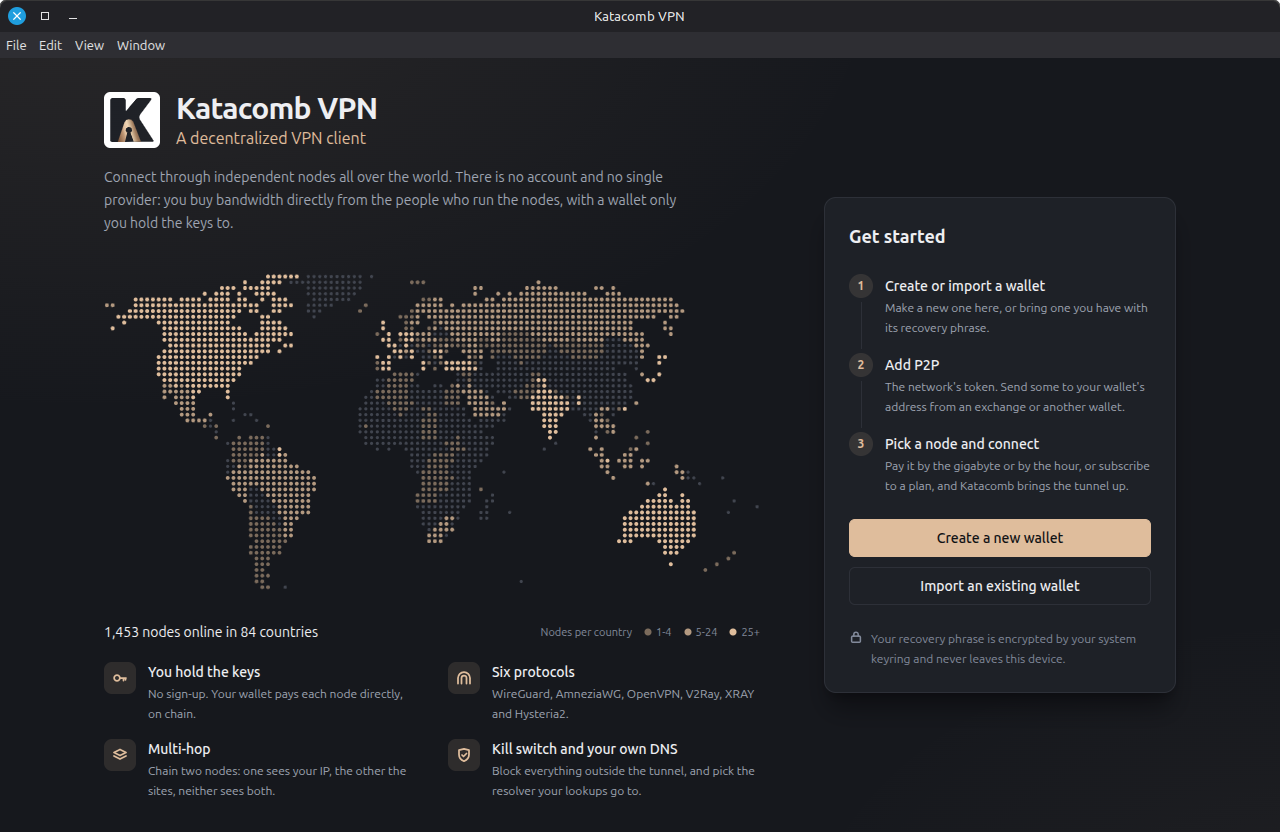
Katacomb VPN welcome screen: create or import a wallet, then pick a node
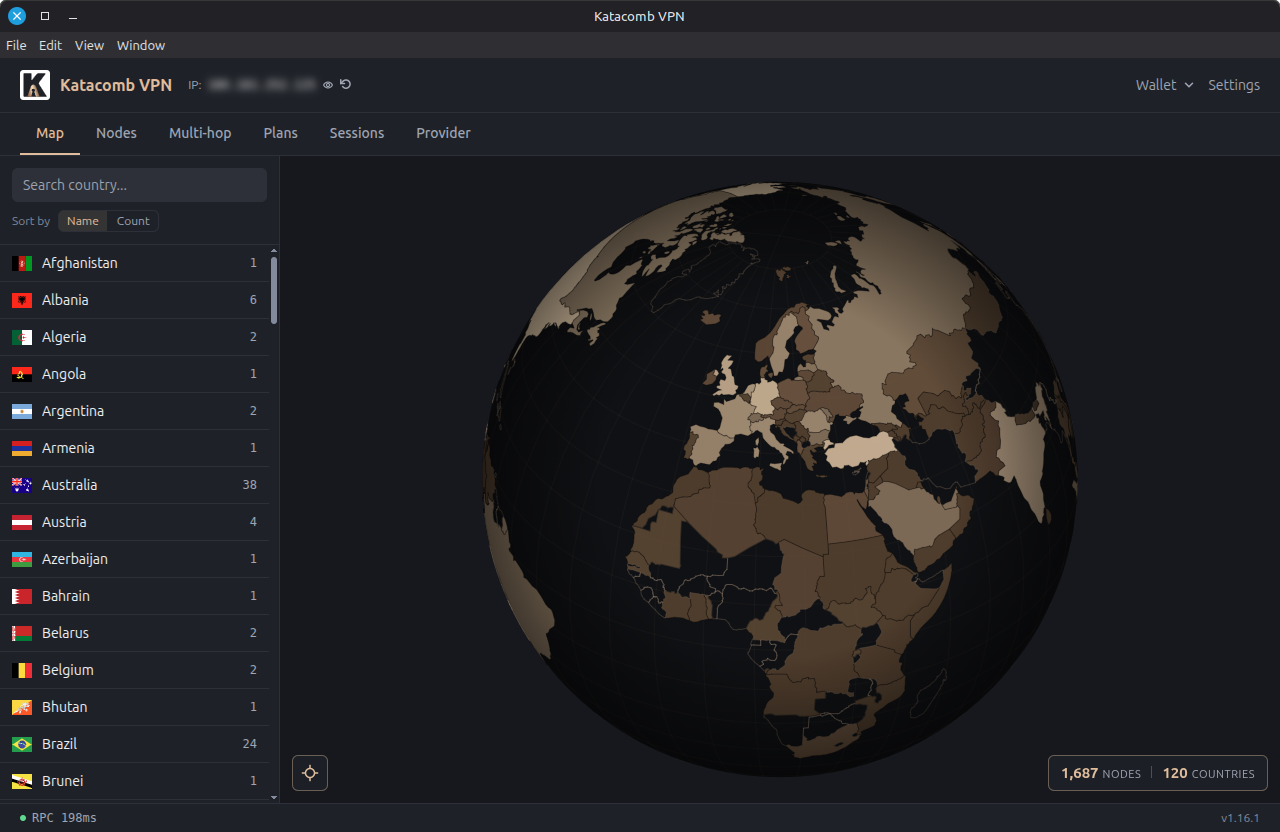
Katacomb VPN 3D globe map with per-country node counts and live network size
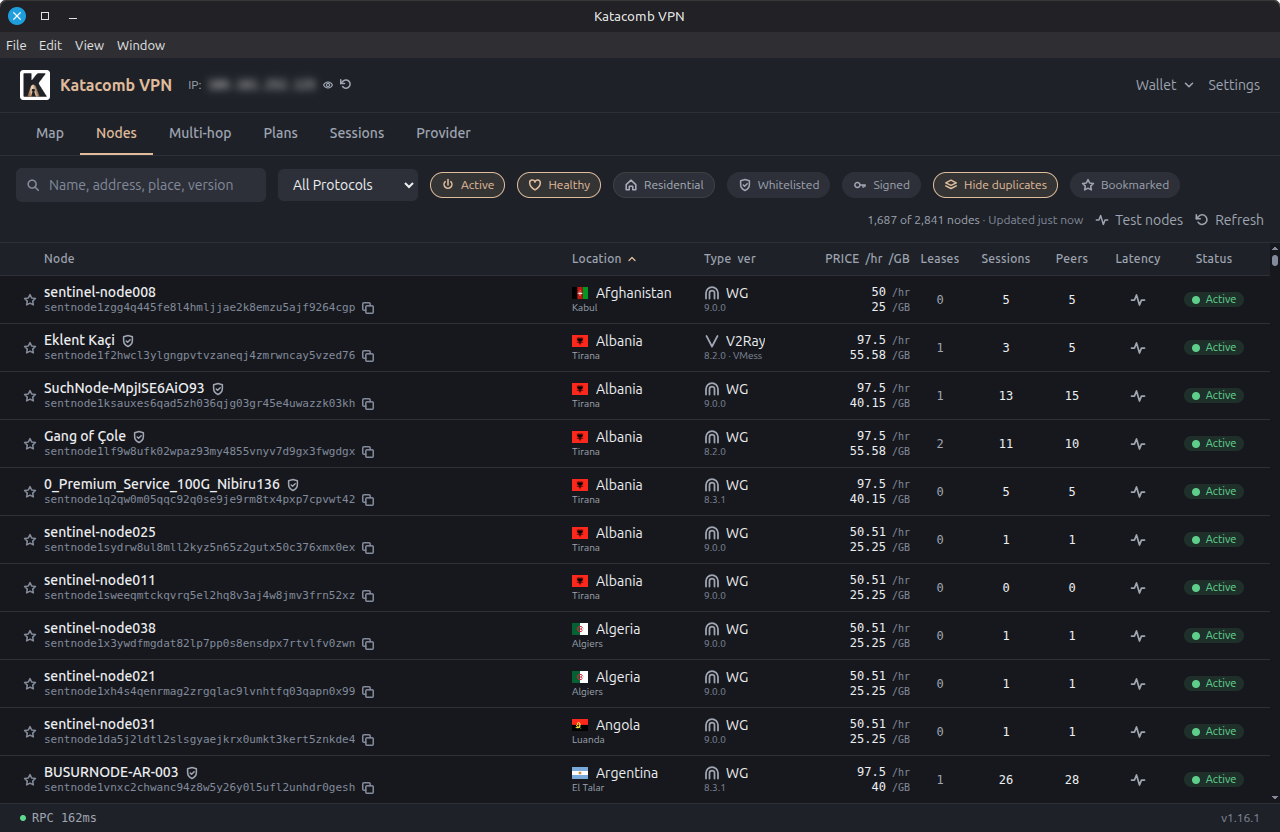
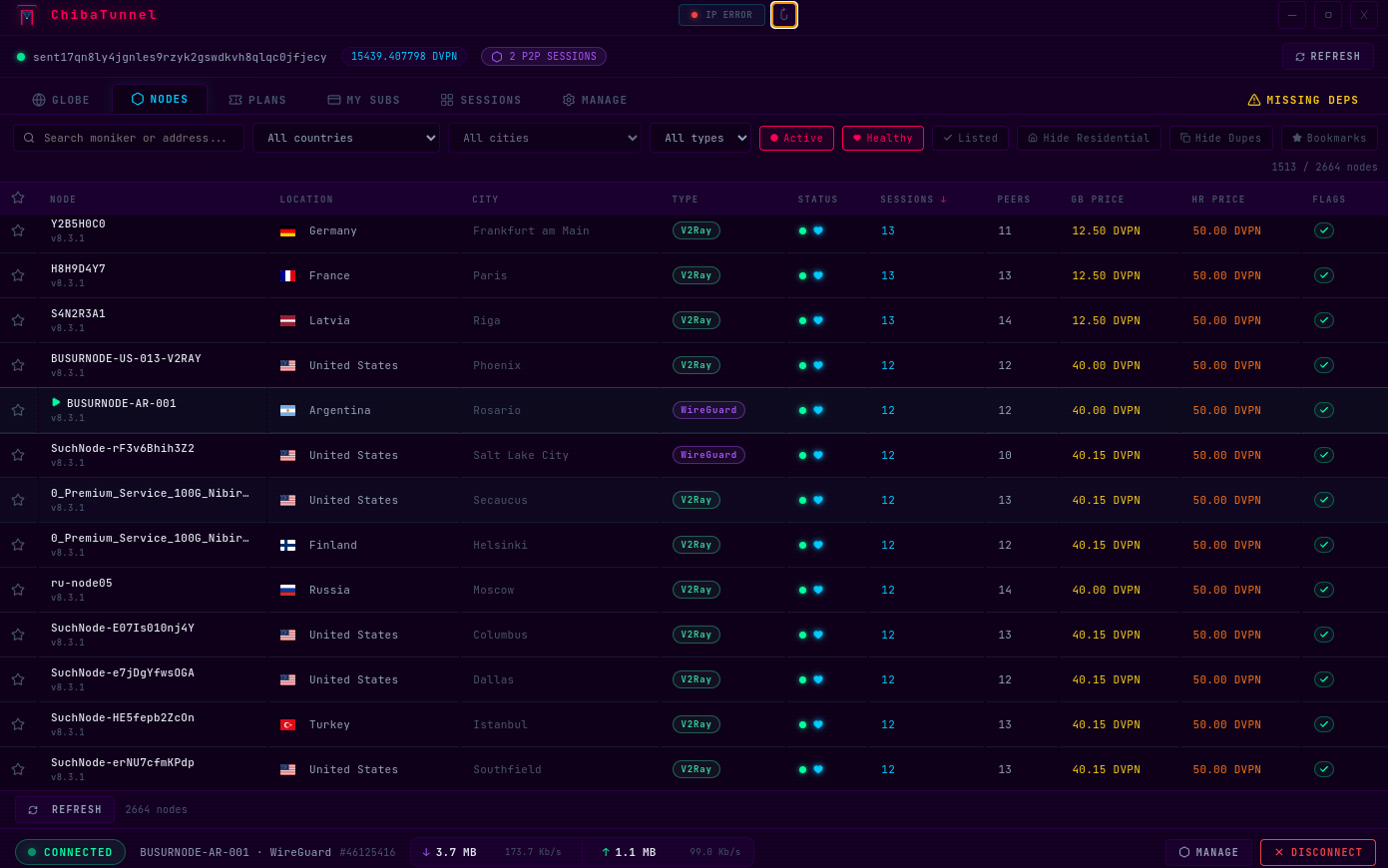
Katacomb VPN node table listing the whole network with per-GB and per-hour prices
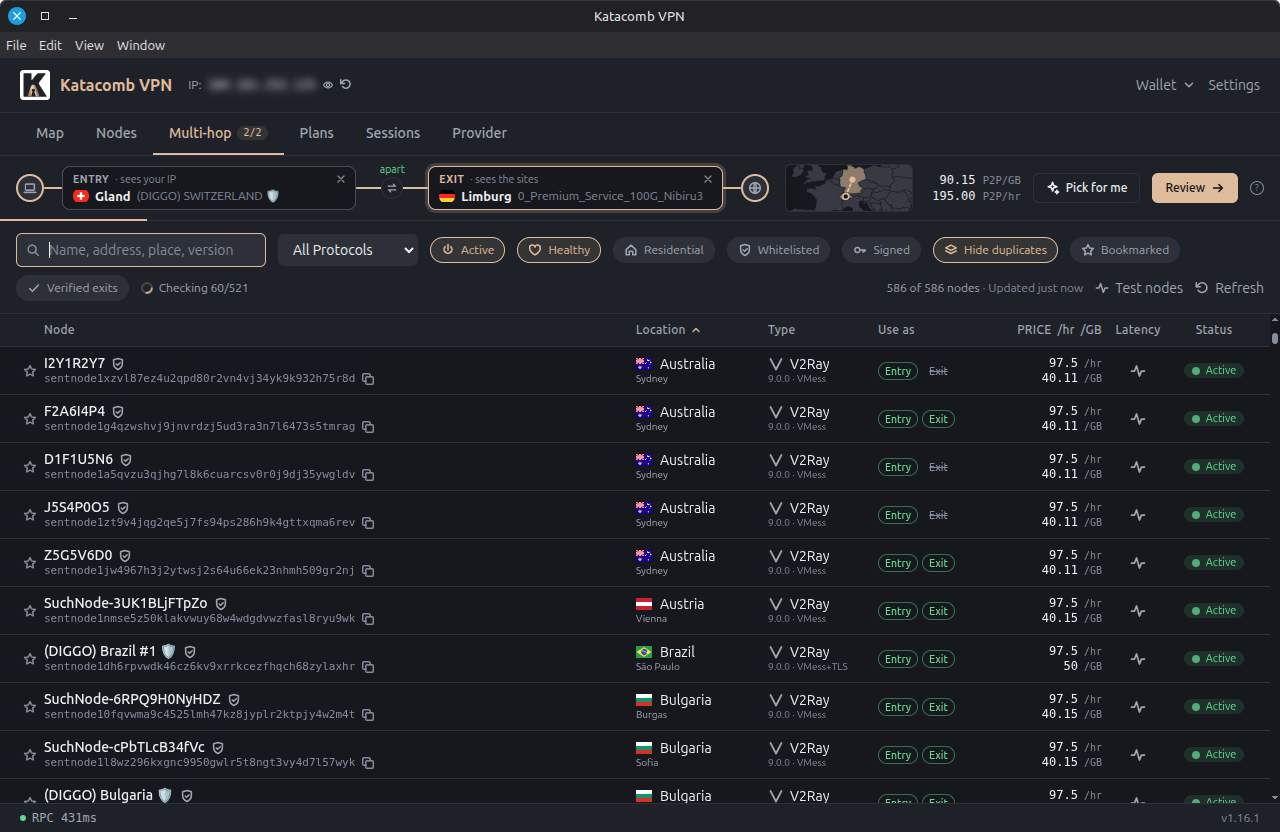
Katacomb VPN multi-hop screen for choosing an entry and an exit node
Linux x86_64 6 protocols v1.16.1

Katacomb VPN

proofoftrinity.github.io/katacomb-vpn · Trinity · built on Sentinel

Katacomb is the power tool of this roundup: a GPL-3.0 desktop client built in Electron, React and TypeScript for Linux x86_64 only, published by Sentinel validator Trinity. It describes itself plainly — pick a node anywhere in the world, pay for a session on-chain, and Katacomb brings the tunnel up on WireGuard, AmneziaWG, OpenVPN, V2Ray, XRAY or Hysteria2, whichever that node speaks. There are no accounts and no subscription to a single provider: bandwidth is bought directly from independent node operators with a wallet you hold the keys to, and everything runs locally against the chain, so there is no Trinity server in the path at all. It ships as a .deb (Debian 11+, Ubuntu 20.04+) or a portable AppImage, both with published SHA256 checksums.
  • Six protocols, one client: WireGuard, AmneziaWG, OpenVPN, V2Ray, XRAY and Hysteria2 — each node runs exactly one, and nodes advertising an unknown type are refused rather than guessed at.
  • Map and node table: a 3D globe with per-country counts over a virtualised table of the entire network. Filter by country, city, protocol or bookmark, sort on any column, and probe latency or test download speed before you spend anything.
  • Multi-hop: chain two nodes so the entry sees your IP but not your destination, and the exit sees your destination but not your IP. Candidates are checked against each node’s advertised inbounds before anything is paid for, and the two hops can be paid from separate wallets. Chains work on V2Ray and XRAY only.
  • Kill switch: iptables rules that drop everything outside the tunnel, armed on connect and torn down on disconnect, plus a self-healing marker that repairs stranded rules if the app dies mid-connection.
  • DNS and split tunnelling: choose Cloudflare, Quad9 or NextDNS as your resolver on connect — on the V2Ray-family protocols queries leave over DoH, so the node cannot read them — and send CIDR routes around the tunnel, with private ranges excluded by default.
  • Self-custodied wallet: BIP-39 import or generate, multiple wallets and subaccounts at a chosen index. Seeds are encrypted at rest with the OS keyring, and if the keyring is unavailable, saving is refused rather than falling back to plaintext.
  • Node operators are treated as adversaries: their handshake data becomes configs that wg-quick, openvpn and iptables execute as root, so every node-supplied config passes an allow-list validator first, the privileged helper re-validates independently, bundled binaries are SHA-256 pinned, and the renderer runs sandboxed with context isolation and no Node access.
  • Provider mode: run the other side of the network — register a provider, create and activate plans, lease nodes and read subscriber counts off the chain, with an economics strip tracking daily burn, escrowed funds and revenue net of the hub’s cut.
  • Honest limits: connecting spends real funds, because a session is a blockchain transaction priced in udvpn — client-side failures are refunded automatically, a session you actually used is not — and multi-hop does not make you anonymous, since two operators working together can still correlate a circuit on volume and timing. Storing a wallet also needs an OS keyring.
  • Linux only
  • Desktop
  • 6 protocols
  • Multi-hop
  • Provider mode
  • GPL-3.0
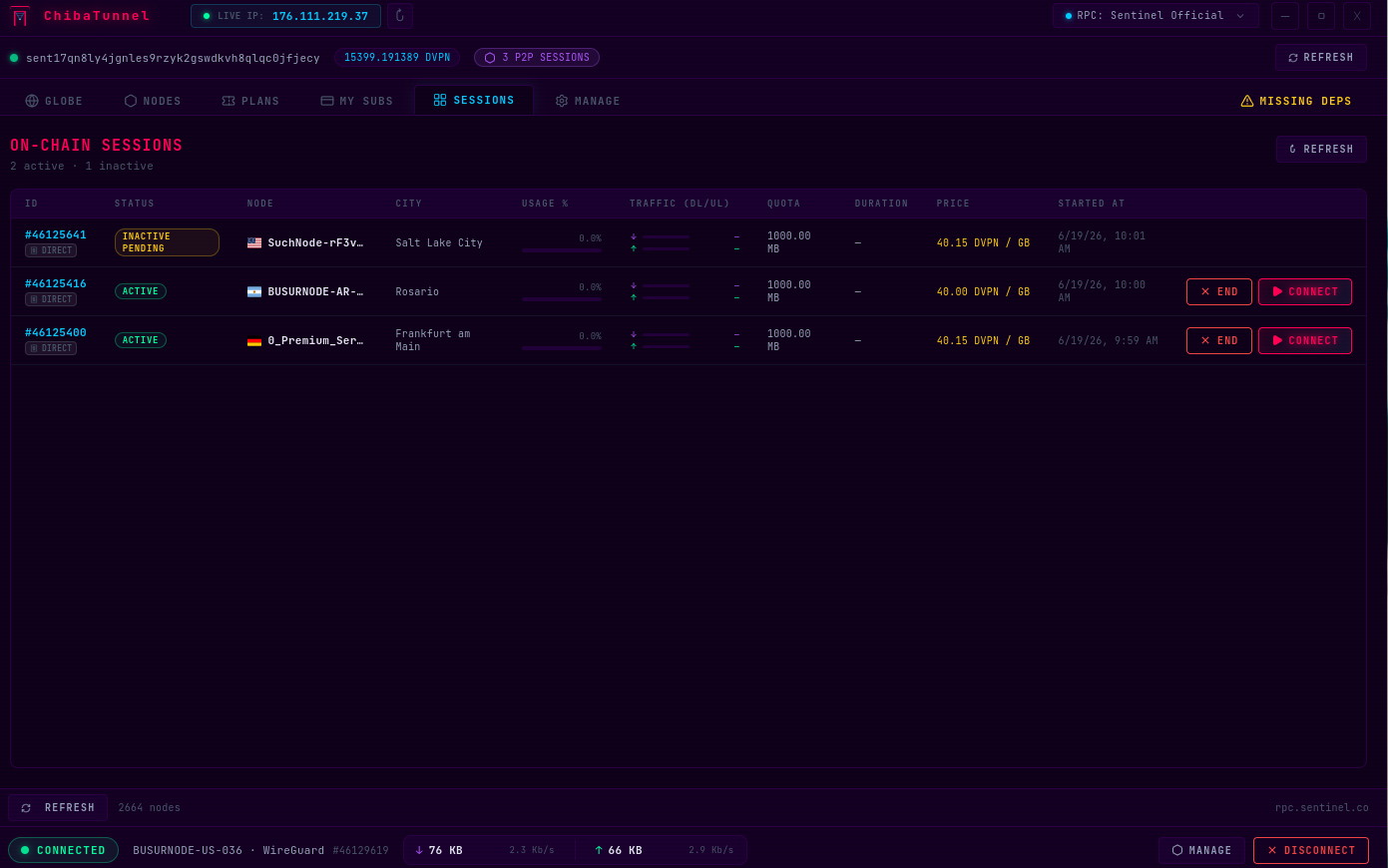
ChibaTunnel node selection screen showing global dVPN nodes
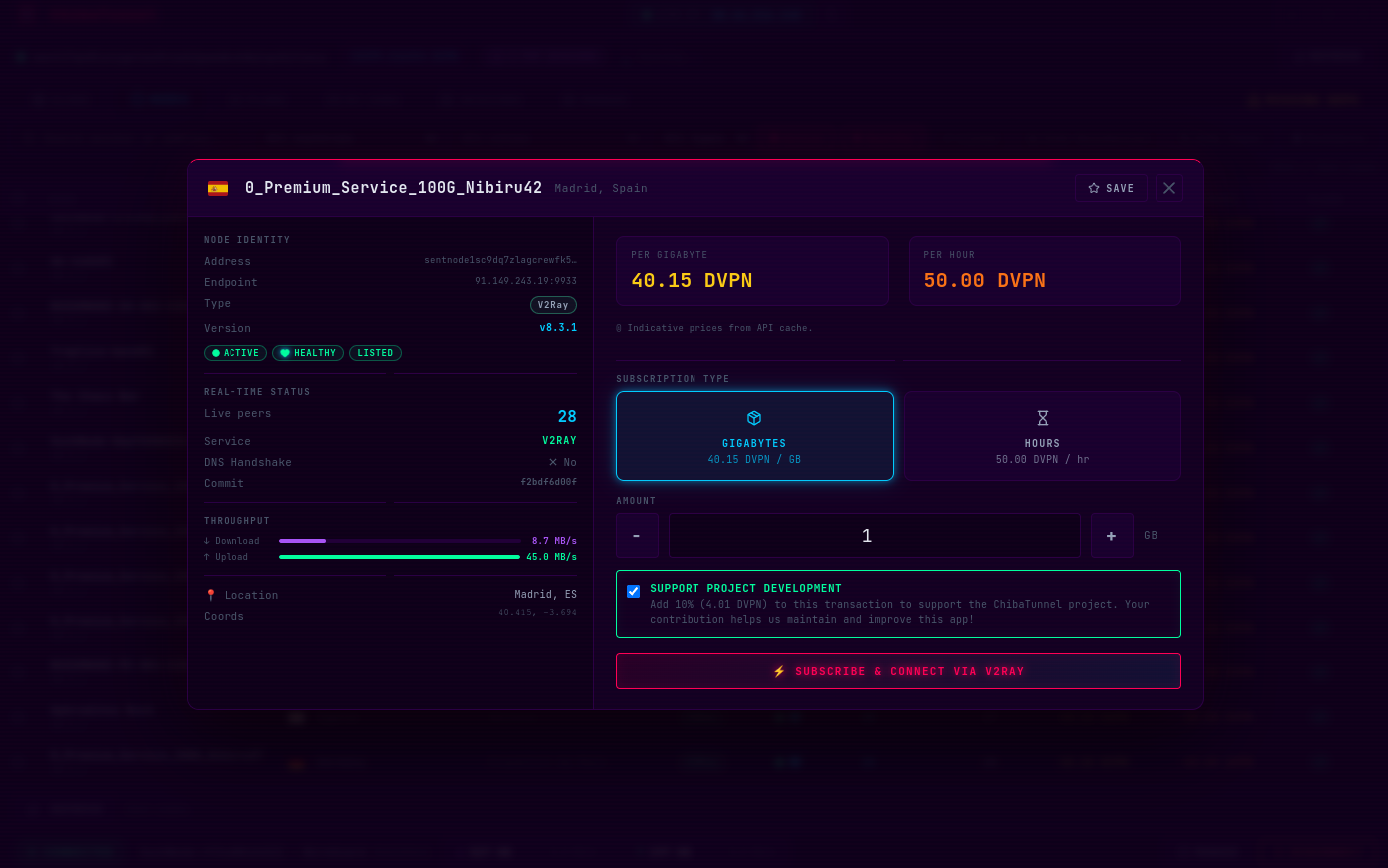
ChibaTunnel connection screen with data and time billing options
ChibaTunnel session management dashboard
Linux · Windows · macOS 6 protocols Pay per use

ChibaTunnel

chibatunnel.xyz · Tkd-Alex · built on Sentinel dVPNX v9

ChibaTunnel is the free, open-source, multi-platform desktop client for Linux, Windows and macOS that turns Sentinel’s multi-protocol node architecture into a single experience. Six protocols — WireGuard, V2Ray, OpenVPN, Xray, AmneziaWG and Hysteria2 — sit behind one secure connection lifecycle, so you pick raw speed, battle-tested compatibility, adaptable proxying or censorship-resistant transport node by node, session by session. It is built on Sentinel dVPNX v9 and the official Sentinel JS SDK v2.1.0 by Tkd-Alex, a Sentinel network validator. Logging is not a policy setting here either: with no central entity in the path, there is nothing that could keep a log in the first place.

  • Six protocols, three platforms: WireGuard, AmneziaWG and OpenVPN as full tunnels, V2Ray, Xray and Hysteria2 in SOCKS or protected TUN mode — normalised behind one connection lifecycle instead of one client per transport.
  • One codebase, three desktops: Linux (.deb, .AppImage, .rpm, .pacman), Windows (.exe) and macOS (.dmg) builds published automatically from the same Electron, React and TypeScript source, with a multilingual interface covering nine languages.
  • Two billing modes, both on-chain: pay per use locks an escrow deposit at session start and releases it automatically when you disconnect, billed by data consumed or time connected; or a subscription plan grants an on-chain allocation across a curated node pool you can switch between without ever re-depositing.
  • Built on Sentinel dVPNX v9 and the official JS SDK (v2.1.0), so the client tracks Sentinel’s own multi-protocol node architecture and blockchain handshakes rather than a hand-rolled fork.
  • Cosmos interoperability: native IBC support for cross-chain token transfers and multi-chain identity across the wider Cosmos ecosystem.
  • Trustless by architecture, not by promise: encryption happens on your device, nodes are a P2P community mesh rather than company-owned servers, and there is no central entity to seize or shut down.
  • Community and validator backed: maintained by Sentinel validator Tkd-Alex — you can delegate $DVPN to fund development — with the source on GitHub, a Telegram group and network updates via @sentinelp2p.
  • Win · macOS · Linux
  • 6 protocols
  • Per-MB or per-hour
  • Escrow on-chain
  • Cosmos IBC
  • Apache-2.0

Pay for privacy without identifying yourself.

The dVPN model is not automatically better — it is differently trust-minimized. It trades raw speed and polish for an architecture where no company holds the keys to your traffic, and no invoice holds your name. Start with a small metered session, verify the clients are open source, and decide for yourself which trade you need.